

Most AI products look impressive in a controlled setting. The real test is what happens when they leave the lab — and that is where most of them fail.
The gap between an AI demo and a production system is not a matter of degree. It is a matter of kind. Demos are designed to perform under ideal conditions. Enterprise systems have to survive everything else: messy inputs, unpredictable users, interconnected infrastructure, and failures that have real consequences.
An enterprise AI system is not judged by how smart it sounds. It is judged by how reliably it performs under pressure, week after week.
"A slightly less intelligent system that works 99% of the time is more valuable than a brilliant system that fails unpredictably."
What changes in the real world
Moving from demo to deployment is not a deployment problem — it is a design problem. The moment you leave the controlled environment, every assumption you made gets stress-tested.
01
Context becomes critical
Real workflows require user history, business rules, and structured and unstructured data working together. Without context wired in, even the best model produces brittle results.
02
Reliability over intelligence
Enterprises do not want impressive AI. They want dependable systems. The benchmark shifts from capability to consistency.
03
Integration is the real work
The model is one layer. The complexity lives in CRMs, APIs, backend workflows, and data pipelines. This is where most AI products quietly break.
04
Latency and performance
Delays destroy user experience and erode trust. In voice AI especially, speed is not a nice-to-have — it is the product.
05
Privacy and deployment constraints
Many businesses require offline capability, private deployments, or controlled data environments. These constraints must be designed in from the start, not retrofitted later.
From model to system
Most conversations about AI focus on the model — its capabilities, its outputs, its benchmark scores. But what businesses actually need is a system that solves a specific problem, reliably, within their existing infrastructure.
What can the model do?
Models — Prompts — Outputs
→
What problem does the system solve?
Systems — Workflows — Outcomes
This is the shift that separates teams building impressive prototypes from teams building things that actually get used.
What actually works
From our experience building at Zencia, the systems that hold up in production share a few consistent traits. They have clear use-case boundaries — they do not try to be everything. They are built on solid backend architecture. They integrate tightly with existing workflows rather than sitting beside them. They include continuous monitoring and a path for ongoing improvement. And they have human fallback mechanisms for the cases the model cannot handle well.
AI is not a layer you add on top of a system. It has to be designed into the system from the beginning.
The next wave of enterprise AI will not be defined by bigger models or better demos.
It will be defined by systems that operate reliably in real environments — embedded deeply in the workflows that businesses run on, trusted enough to be infrastructure.
The winners will not be the ones who build the smartest models. They will be the ones who build systems that work, systems that scale, and systems that businesses can actually trust.
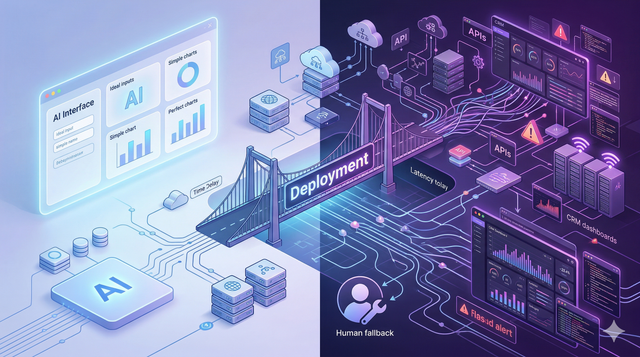
Building AI That Actually Works: Lessons from Real-World Deployments
Deploying AI in a real business environment is a fundamentally different problem from building a demo. Seven lessons from the field on what it actually takes to make AI work in production.
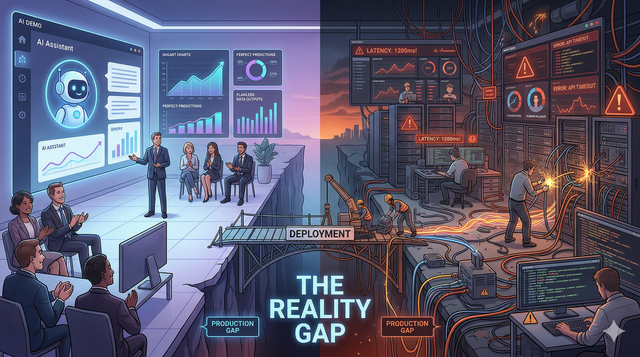
The Gap Between AI Demos and Production Systems
Every AI demo looks impressive. Production is where the real test begins — and where most systems quietly fall apart.