
Building AI That Actually Works: Lessons from Real-World Deployments
Deploying AI in a real business environment is a fundamentally different problem from building a demo. Seven lessons from the field on what it actually takes to make AI work in production.
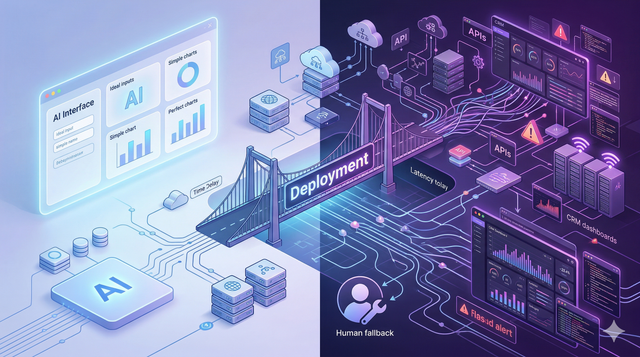
AI looks easy — until you try to deploy it in a real business environment. A demo works perfectly. The model responds intelligently. Everything looks smooth. Then you take it into production, and things change.
Users behave unpredictably. Inputs become messy. Systems need to connect with one another. And suddenly, the working AI starts breaking. What becomes clear quickly is that AI that works in production is a fundamentally different problem from AI that works in demos.
"The real challenge is not building AI. It is embedding it into the systems that businesses already run on."
Lessons from deployment
01
Define a clear use case before anything else
"Build a chatbot" is not a use case. "Automate customer query resolution for billing issues" is. AI systems perform best when the problem is well-defined, the scope is controlled, and the outcomes are measurable. Vague use cases produce vague results. Clarity beats complexity every time.
02
Context is everything
Models do not understand your business out of the box. To make AI genuinely useful, you need structured business logic, historical data, workflow context, and a clear map of user intent. Without that context wired in, even the best models produce outputs that are irrelevant to the actual problem.
03
Reliability matters more than intelligence
In production, consistency wins. A system that works predictably is more valuable than one that occasionally produces brilliant results but fails randomly. Enterprises care about uptime, accuracy consistency, and graceful fallback handling — not just smart responses.
04
Integration is where most systems fail
AI is not a standalone product. It needs to connect with CRMs, internal tools, APIs, and databases. The model is one layer — the complexity lives in everything around it. Building the model is rarely the hard part. Embedding it into existing systems is where most AI products quietly break.
05
Speed is core to design, not an afterthought
Latency kills experience. In conversational and voice systems especially, delays break interaction flow and users lose trust instantly. Performance optimization is not an optional improvement to make later — it is a core constraint that must shape the architecture from day one.
06
Design for failure from the start
No AI system is perfect. Every production deployment will encounter incorrect responses, edge cases, and unexpected downtime. Strong systems plan for this: fallback mechanisms, human handoff, monitoring, and feedback loops. AI should fail gracefully, not catastrophically.
07
Privacy and deployment constraints change everything
Not every business can use cloud-based AI freely. Real-world deployments often require on-premise setups, offline capabilities, and strict data privacy controls. These are not edge cases — they are common enterprise requirements that change the architecture of the system completely.
What actually works
Across real deployments, the AI systems that hold up in production share a consistent set of traits.
Foundation
Clearly defined use cases
Architecture
Strong backend design
Integration
Tight workflow embedding
Operations
Continuous monitoring
Process
Iterative improvement
Safety
Human fallback mechanisms
AI is not a feature you plug into an existing product. It is a system you build around real business needs — with the same rigor, care, and operational discipline you would apply to any critical piece of infrastructure.
The teams that get this right are not the ones chasing the most powerful models. They are the ones who understand that deployment is the product.

From Hype to Reality: What It Takes to Build Enterprise AI System
Most AI products look great in a demo. Building systems that actually work inside a company is a different problem entirely — and most teams underestimate it.
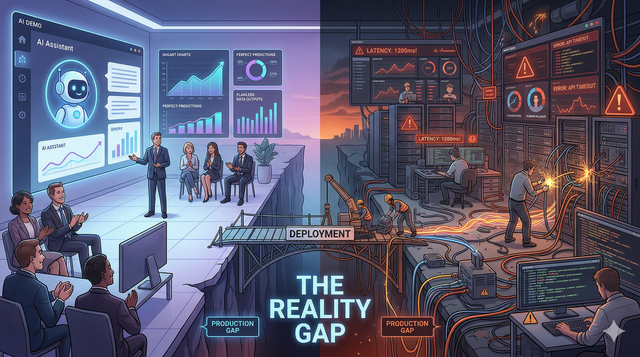
The Gap Between AI Demos and Production Systems
Every AI demo looks impressive. Production is where the real test begins — and where most systems quietly fall apart.