
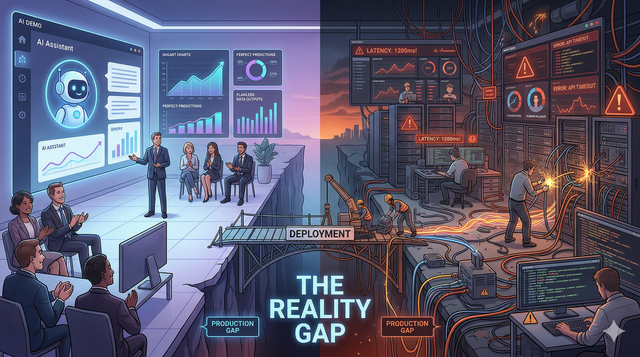
There is a moment every AI builder knows well.
The demo runs perfectly. The model responds with precision. The stakeholders are impressed. Everyone in the room believes the hard part is done.
It is not. In most cases, it has not even started.
The gap between an AI demo and a production system is one of the most underestimated problems in technology today. It is not a gap of capability — modern models are genuinely powerful. It is a gap of design, architecture, and operational discipline. And it is the reason so many AI initiatives stall after the first successful prototype.
---
Why demos always work
A demo is a controlled environment. The inputs are curated. The scenarios are rehearsed. The edge cases have been quietly removed. The infrastructure is simplified to make the model shine.
This is not dishonest — it is just how demos work. You show the best version of what a system can do. The problem arises when teams mistake that best-case performance for a baseline.
In production, there is no curation. Users say things the system was not trained to handle. Data arrives incomplete, inconsistent, or in formats the model was never tested on. Workflows branch in directions no one anticipated. The controlled environment is gone, and with it, the illusion of reliability.
---
What production actually demands
When an AI system moves from demo to deployment, the criteria for success change entirely.
In a demo, the question is: can this model produce an impressive output?
In production, the questions are different: Does it work consistently, across every user, every input, every edge case? Does it integrate with the systems the business already depends on? Does it perform fast enough that users trust it? What happens when it gets something wrong? Who is responsible for monitoring it over time?
These are not model questions. They are system questions. And most AI products are built to answer the first question while ignoring the rest.
---
The integration problem
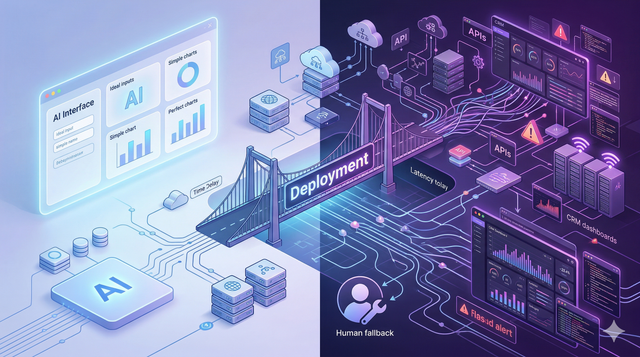
The model is rarely where production AI breaks. It breaks at the seams — the points where AI connects to the rest of the business.
CRM integrations that were not designed with AI in mind. APIs that return inconsistent data structures. Internal tools built years ago that have no clean interface for a modern system to talk to. Data pipelines that work in staging but fail under real load.
Building the AI layer is one problem. Embedding it into the infrastructure a business already depends on is a different problem entirely — and usually a harder one.
Most teams discover this only after the demo has been approved and the timeline has been set.
---
The reliability gap
There is a common assumption that a more intelligent model is a more valuable model. In enterprise environments, this is often wrong.
A system that is slightly less capable but works 99% of the time is more valuable than a system that occasionally produces exceptional results but fails without warning. Businesses are not looking for impressive AI. They are looking for dependable AI — systems they can build processes around, systems that behave the same way on a Tuesday afternoon as they do in a Friday morning demo.
Reliability requires more than a good model. It requires fallback mechanisms, monitoring, human handoff protocols, and a feedback loop that catches degradation before it becomes a user-facing problem. These are operational concerns, not research concerns, and they rarely appear in a demo.
---
The cost of getting this wrong
When a demo fails, the cost is a conversation. When a production system fails, the costs are real: broken workflows, lost user trust, support overhead, and the political fallout of an initiative that promised results and delivered problems.
This is why the gap matters. It is not an abstract engineering concern. It is a business risk that is consistently underpriced because the demo made everything look solved.
---
Closing the gap
The teams that successfully move from demo to production share a few consistent habits.
They define the use case precisely before they write a line of code. They design the integration layer with as much care as the model layer. They test against real, messy, production-grade inputs — not curated samples. They build monitoring in from the start, not as an afterthought. They plan explicitly for failure: what the system does when it does not know the answer, when an integration is down, when a user does something unexpected.
Most importantly, they treat deployment as the product — not a step that happens after the product is built.
The demo is a proof of concept. The production system is the actual commitment. The gap between them is where most AI initiatives either grow up or quietly disappear.

From Hype to Reality: What It Takes to Build Enterprise AI System
Most AI products look great in a demo. Building systems that actually work inside a company is a different problem entirely — and most teams underestimate it.
Building AI That Actually Works: Lessons from Real-World Deployments
Deploying AI in a real business environment is a fundamentally different problem from building a demo. Seven lessons from the field on what it actually takes to make AI work in production.